

Self-Discipline Is Probably Not the Problem
Most of us are not lacking self-discipline; we are disciplined every single day.
We meet deadlines. Show up for clients. Keep businesses moving. Remember birthdays. Handle logistics. Follow through when other people are depending on us.
The inconsistency usually appears somewhere else. In the promises made to ourselves:
- The walk that you keep postponing
- A boundary you cross
- An evening that was meant to be restful but somehow fills up with more work.
We are not incapable of discipline; it's that our own word has gradually become negotiable.
What You Repeatedly Honour Matters
There’s a difference between intending something and honouring it.
Most women already know what would support them: more rest, clearer boundaries, less overcommitting, more space, and more honesty about their actual capacity.
The problem is rarely awareness. The problem is that those things are often treated as optional the moment something else feels more urgent. And over time, that changes something internally.
Your life reflects what you repeatedly honour, not what you repeatedly intend. That can be uncomfortable to acknowledge, but it’s also empowering. Because it shifts the conversation away from capability and towards choice.
How Your Own Word Loses Authority
Every time you repeatedly move your own needs to the bottom of the list, your internal standards begin to weaken.
Not externally, most women still appear highly capable from the outside. But internally, something becomes less solid. You stop fully expecting yourself to follow through for you.
The promise to rest becomes flexible, the commitment to slow down gets renegotiated and the boundary disappears as soon as someone else is disappointed.
Over time, your own word stops carrying the same authority internally that it carries externally. This matters because self-leadership is not built through what you say matters. It is built through what you consistently honour.
The Pattern Often Looks Responsible
This is why these behaviours can be difficult to recognise. They are often rewarded.
- Being available looks supportive.
- Pushing through looks productive.
- Saying yes looks generous.
- Keeping everything going looks capable.
From the outside, many of us are praised for the very patterns that are exhausting us internally, which means the behaviour rarely gets questioned. It simply becomes normal.
And eventually, the gap between what you need and what you actually honour becomes so familiar that you stop noticing it altogether.
Self-Leadership Starts in Small Moments
Most people think self-leadership is about confidence, visibility, or high performance. I think it starts somewhere inside you, what I might call our inner voice (or intuition/wisdom).
This might look like listening to yourself when something feels off or noticing your boundaries mean something once they inconvenience someone or in the promises you make to yourself hold weight in your actual life. It doesn't have to be perfect, what you're looking for is consistency.
Because every small moment of follow-through reinforces something important:
- “My needs matter too.”
- “What I said I needed is still important.”
- “My word means something here.”
That is how we rebuild internal authority.
Integrity Is Built In Little Moments
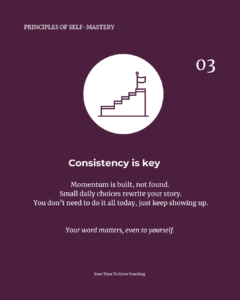 The good news is that this work doesn't require huge breakthroughs or overnight transformations; in fact, more often, it looks like: stopping when you said you would stop, resting without earning it first, declining something before resentment builds, and following through on one thing that genuinely matters to you.
Small moments repeated consistently shape identity. The women who trust themselves deeply are not necessarily more motivated than everyone else. They have simply learned to stop negotiating with the things they know matter.
A Different Standard
There comes a point where the question is no longer: “Why can’t I stay consistent?”
The better question becomes: “Why do everyone else’s needs, comfort, urgency, or expectations keep carrying more weight than my own?”
That question changes things because it moves the conversation away from discipline and back towards self-respect.
A Next Step
This is exactly the work we explore inside Taking Off the Armour and The Arena.
In my spaces I invite you to lay down the idea of becoming more productive or more perfect, and instead learning how to honour yourself consistently enough that your own word begins to carry weight again.
Closing Reflection
Where in your life has your own word quietly become negotiable?