

There’s a phrase I hear often from women I work with:
“I’m just inconsistent.”
Usually, it’s said after another moment where they didn’t do the thing they told themselves mattered. They skipped the walk they’d promised themselves they needed, ignored the boundary they knew they should hold, or filled the only free hour in their week with more work because other things suddenly felt more important.
After a while, those moments begin to stack up: evidence that they can’t rely on themselves; that they always end up back in the same place. Evidence that no matter how aware they are, nothing really changes.
But I don’t think inconsistency is the real issue most of the time.
What I see far more often is women quietly breaking trust with themselves in small, almost invisible ways. Not intentionally. Just repeatedly enough that the relationship with themselves starts to feel unsteady.
How Trust With Yourself Gets Broken
Self-trust isn’t built through huge declarations or perfectly executed routines. It develops through ordinary moments where you notice what you need and respond to it honestly.
Sometimes that looks like resting when your body is clearly asking for a pause instead of overriding the exhaustion and carrying on anyway. Other times, it’s recognising that your capacity has been exceeded and allowing yourself to adjust, rather than forcing yourself to keep pushing because everyone else seems to need something from you.
None of those moments is particularly glamorous, but they matter far more than people realise. Because every time you override what you know to be true for yourself, something internal registers it.
Not consciously perhaps, but somewhere deeper, a message lands:
“What I need can wait.”
“What I feel isn’t important.”
“Other things matter more.”
Repeated often enough, those moments shape the way you relate to yourself.
Why Discipline Isn’t the Real Issue
Most people assume the answer is discipline. Better habits. More accountability. A stricter routine.
And while structure can absolutely be supportive, many high-functioning women are already incredibly disciplined in multiple areas of their lives. They manage businesses, teams, families, clients, deadlines, logistics and responsibilities every single day.
The difficulty is rarely capability.
More often, their own needs consistently lose against urgency, expectation, responsibility, or guilt. The promise they made to themselves disappears the moment something else feels more pressing.
It's not because they are lazy and it's not because they don’t care. It's because they learned very early to move away from themselves quickly.
The Habit of Leaving Yourself Behind
For some women, being productive became tied to worth. For others, being easy-going kept relationships smoother. Sometimes, pushing through exhaustion was praised as strength, resilience, or reliability.
Over time, those responses stop feeling like choices and simply become “who you are.”
That’s why this work matters so much.
So often we think we need to become someone different, but that's not true. It's just because so many of us have become so used to overriding ourselves that we barely notice it happening anymore.
The real shift begins when you start paying attention to those moments in real time:
- When you realise you’re exhausted but continue anyway.
- As you hear yourself say “it’s fine” when it clearly isn’t.
- The moment you promise yourself rest and immediately fill the space with something more productive.
Individually, they seem insignificant. Together, they create a pattern of self-abandonment that slowly erodes trust. Eventually, you stop fully believing yourself.
You stop trusting your own boundaries because you know you probably won’t honour them. You stop trusting your own intentions because experience tells you they’ll be overridden the second someone else needs something.
That’s when we often label ourselves inconsistent.
But inconsistency suggests randomness. Most of the time, these patterns are actually deeply consistent. You consistently abandon your own needs in favour of something else.
That’s a very different thing.
The Small Moments That Change Everything
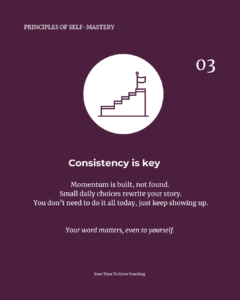 The good news is that self-trust can be rebuilt.
And there's no need for dramatic promises or reinventing yourself overnight; instead, I am advocating for small moments of follow-through that begin restoring safety internally.
- Keeping one promise to yourself matters.
- Holding one boundary matters.
- Pausing before automatically saying yes matters.
Tiny moments of self-respect are often far more powerful than huge declarations about becoming a “better” version of yourself.
And this isn’t about perfection. You will still override yourself sometimes. Old patterns will still appear. There will be days when you notice the behaviour halfway through instead of beforehand.
That doesn’t mean you’ve failed.
The work is simply noticing sooner, reconnecting more quickly, and learning to stay with yourself long enough for your own needs to matter again.
Rebuilding Trust Quietly
This is exactly the work we explore inside Taking Off the Armour and The Arena.
Not becoming someone new, but learning how to hear yourself more clearly, honour what matters, and stop leaving yourself behind in the process.
A Different Question to Ask Yourself
So perhaps the better question isn’t:
“Why am I so inconsistent?”
Perhaps it’s: “Where have I stopped believing that my own needs deserve to be honoured?”