
Over the past few years, I've been on quite a journey of personal growth. One of the most significant things I've discovered is that so much of what I thought I needed to become was already there.
I've spent time reflecting on who I am, what I'm capable of and the ways I've sometimes held myself back. I've come to recognise something that sounds incredibly simple but has taken me a long time to really understand.
I don't need to become someone different before I can start being who I want to be.
Having been a coach for more than ten years, I've facilitated groups, supported people through significant changes and built a wealth of experience along the way. Yet at times, I've underestimated what I bring. I've questioned whether I should speak up or looked to other people for reassurance about my capabilities.
Through my coaching journey with Rebecca, I've begun to recognise how much of that was about how I saw myself, rather than what I was actually capable of. I didn't need someone else to give me permission to own my experience, knowledge, or ability; I needed to recognise those things in myself.
That's not to say I haven't grown or developed new skills. Of course I have. But the biggest shift has been in how willing I am to acknowledge and express who I already am. The more I do that, the more I notice how differently I participate in conversations, approach opportunities and make decisions.
Which has got me thinking about possibility.
Do we have to create possibilities?
November's Self-Mastery Principle is Invite Yourself Into Possibility, and I've spent the past few weeks exploring what that might mean.
When we think about creating possibilities, we often focus on what we need to do. We need to put ourselves forward, find new opportunities, make connections, take risks or make different decisions. Of course, those things matter, but I wonder whether we sometimes approach possibility as though it's another thing we need to achieve.
Something we have to work hard to create before we can become the person we want to be. What if we've got that the wrong way round? What if possibility begins with who we're being?
Who we are being changes what becomes possible
October's Self-Mastery Principle was Who You Are Being Shapes Who You Become, and I've been reflecting on how closely that connects to November's theme.
I don't think who we're being only influences who we become; I think it also influences what becomes possible in our lives. Being honest about what we think and feel allows other people to understand us more fully. Acknowledging our capabilities rather than downplaying them gives people an opportunity to recognise what we bring.
Expressing what we want, instead of assuming it isn't available to us, opens up conversations that might otherwise never happen. And when we stop trying to anticipate everyone else's reactions, we create space for them to respond for themselves.
None of this guarantees a particular outcome. Someone might disagree with us. An opportunity might not work out. We might ask for something and receive a no...and yet something has changed.
We've allowed ourselves to participate in the situation as we really are, rather than as the person we think we're supposed to be. That changes what becomes possible.
How often do we hide who we really are?
Let's consider our protective strategies. Many of us have learned ways of behaving that help us feel accepted, capable or safe. We might become the person who always has the answers, the one who keeps everyone happy or the one who doesn't need anything from anyone else.
Perhaps we've learned to hold back our opinions, minimise our achievements or wait until we're absolutely certain before putting ourselves forward. These behaviours can become so familiar that we don't always recognise when we're doing them. And while they may have served a purpose, they can also limit how much of ourselves we allow other people to experience.
I've recognised this in myself. There have been times when I've held back, questioned whether I should say something or worried about how I might be perceived. I've sometimes made assumptions about what other people might think, want or be willing to consider. In doing so, I've denied them the opportunity to decide for themselves.
And when I do that, I'm not showing up as fully as I could. I'm presenting a version of myself that's been filtered through my expectations of other people's responses. Which means they don't necessarily get to experience all of who I am. I wonder how many possibilities we close down in this way without ever realising it.
Possibility doesn't require certainty
When I invested in coaching with Rebecca in January 2025, I couldn't have known where the experience would lead. I made the biggest financial investment I'd ever made in myself without knowing exactly what I would get from it.
It was a considered decision. Making a significant investment deserves careful thought, and I'm certainly not suggesting we should ignore practical realities. But there's a difference between making a considered choice and needing certainty about the outcome.
Some things can only be discovered through experience. We can prepare, ask questions, consider what matters to us and make the best decision we can with the information available. Then we have to allow life to unfold.
I think the same is true when we begin showing up more fully as ourselves. It's impossible to know what opportunities might emerge from being more visible, honest or willing to express what we want.
We might discover something unexpected or learn that a particular direction isn't right for us. Perhaps the possibility we were imagining was much smaller than what eventually became available and we won't discover any of that if we insist on knowing the outcome before we're willing to participate.
Being yourself is a choice you make repeatedly
I don't think being fully ourselves means we always feel confident, know what to say or find every situation comfortable.
There are still moments when I notice myself wanting to hold back or retreat into familiar behaviour. Sometimes I recognise it immediately. Sometimes it takes a little longer.
What's changing is my awareness that I have a choice about how I respond. I can notice the story I'm telling myself and consider what I'm trying to protect myself from. That allows me to decide who I want to be in that moment, even when I don't know how things will turn out.
For me, that's where Self-Mastery comes in. It's about becoming aware of the choices we're making and taking responsibility for how we want to participate in our own lives.
Sometimes that means speaking up, asking a question, expressing a need or allowing ourselves to be seen. At other times, it means recognising that we don't have to do anything more to prove our worth.
We can simply be who we are.
Inviting yourself into possibility
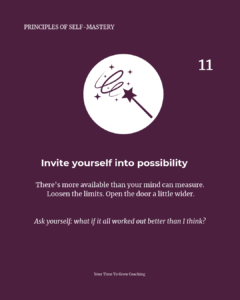 As November draws towards its end, I'm beginning to see Invite Yourself Into Possibility as something much bigger than looking for new opportunities.
It's an invitation to consider how we're showing up in the lives we're already living.
Are we allowing people to experience who we really are?
Perhaps we're still waiting for someone else to recognise our capabilities before we're willing to acknowledge them ourselves.
Or maybe we're holding back from expressing what matters to us because we've already made assumptions about how other people might respond.
And in our efforts to create the next opportunity, I wonder whether we're overlooking what's possible when we stop holding ourselves back.
I still have ambitions, goals and things I want to experience. Taking action, making thoughtful decisions and following through on my commitments remain important to me.
And I'm becoming more interested in what happens when those actions come from a place of knowing who I am, rather than trying to become someone I think I should be.
Looking back over my coaching journey, I can see how much has changed through recognising and owning what was already there.
As I've begun to show up differently, I've opened myself to conversations, experiences and possibilities I might previously have held myself back from. I couldn't have predicted all of that when I started.
Perhaps I didn't need to. Maybe inviting ourselves into possibility begins with allowing ourselves to be fully who we already are, wherever we find ourselves.
So, as you go about your week, I'd love you to consider this:
What might become possible if you stopped waiting to become someone different and allowed yourself to show up more fully as who you already are?