

I've had a slightly uncomfortable realisation this week: there's a big difference between something not working because I'm not trying and not trying because I think something isn't working.
I've been sitting with that distinction because, when I looked a little more closely at what I've actually been doing, I realised I'd fallen into the first camp while telling myself a story that belonged to the second.
And that's quite an important difference.
When old patterns creep back in
I've just finished six months of Beyond Limits, a coaching programme that has helped me recognise and own my power in a way I don't think I've ever quite managed before. I've gone from being on the cusp of knowing how powerful I am to knowing it in my bones.
Yet over the past few weeks, I've also noticed myself slipping back into some familiar habits.
Overthinking. Doubting myself. Avoiding things. Shrinking when I could be stepping forward.
It was almost as though I'd forgotten who I am...which is rather interesting, given that I've just spent six months remembering.
Knowing something and living it are different things
I've been reflecting on why this happened, and I realised that some of the foundational practices that have supported me over the years had slipped out of my daily life.
I didn't consciously decide they weren't important any more. Life got busy, other things took priority and gradually I stopped making space for them.
The funny thing is, I know these practices make a difference to how I think, feel and show up, but when I stopped doing them consistently, rather than noticing that I'd stopped, I began questioning why I wasn't feeling quite so grounded or acting with the same conviction.
I was looking for evidence that things weren't working without being particularly accurate about what I was actually doing.
And I wonder how often we do this?
Have you really given it a chance to work?
We decide something isn't working, but have we really given it the opportunity to work? Have we been consistent enough to know, or have we quietly withdrawn our effort because we weren't seeing the results we hoped for?
Of course, sometimes things genuinely don't work and we need to change our approach. I'm not suggesting we should keep doing something indefinitely just because we've committed to it.
However, there is a difference between evaluating something we've genuinely tried and deciding something doesn't work when we've barely been practising it.
The practices I'm returning to
So this week I've been recommitting to three foundational practices that help me consciously choose who I'm being.
They're not particularly complicated, and I'm not suggesting everyone needs to adopt my morning routine. I thought I'd share a little about them because they've played an important part in my own Self-Mastery journey.
My I AM document
This is a document I've created with that reminds me who I am and who I'm choosing to be. It comes from the book Ultimate Coach by Steve Hardison
It's not a list of things I need to achieve before I can consider myself successful. It's a way of reconnecting with my values, my identity and the woman I know myself to be, particularly when my thoughts are trying to convince me otherwise.
Reading it regularly helps me return my attention to something I've consciously chosen rather than automatically accepting whichever version of myself my doubts are presenting that day.
Affirmations and abundance
Another practice I'm returning to is my affirmations around wealth, health and abundance.
These are statements about the life I'm choosing to create and experience. For example, one of mine is:
“I, Charlie, enjoy incredible adventures with my family.”
It's a simple statement, but it reminds me of what matters to me and what I want to make possible in my life.
For me, this practice is about consciously directing my attention towards the life I want to experience, rather than allowing my thoughts to be dominated by what isn't happening, what might go wrong or what I think is missing.
It's another way of practising who I'm choosing to be, instead of waiting for external circumstances to give me permission to be her.
Acknowledgements
This might be one of the most important practices for me.
It's about deliberately recognising what I've done, how I've shown up and the evidence of who I'm being.
I've written before about how easy it is to overlook our own contribution while keeping a remarkably accurate record of everything we haven't done. Acknowledgements help me challenge that habit.
They also help me be accurate. Sometimes that means recognising something I've done well, and sometimes it means acknowledging where I haven't followed through on something I said mattered.
Both are useful. Neither requires me to beat myself up.
Who are you being when nobody is watching?
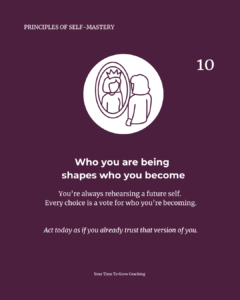 October's Self-Mastery Principle is Who You Are Being Shapes Who You Become, and this week's experience has brought that principle into sharper focus.
It's easy to think about personal growth in terms of the big moments. The breakthroughs, the decisions, the opportunities we say yes to and the times we surprise ourselves with what we're capable of.
But so much of who we're being is shaped in the ordinary moments between those experiences.
What do we repeatedly give our attention to? Which thoughts do we entertain? How do we respond when we doubt ourselves? Do we act from what we know to be true about ourselves, or do we allow familiar protective strategies to make the decisions?
I've realised that I can know I'm a powerful woman and still find myself behaving as though I need permission.
The difference now is that I can recognise what's happening and choose to return to the practices that support me.
I'm not starting again, I haven't lost everything I've learned, I've noticed that I need to practise living it.
Showing up, being consistent and trusting the process
Another part of this realisation has been about the relationship between effort and outcomes.
There are things in my business and life that I want to create, but I cannot control whether or when particular results arrive.
I can share my work, make invitations, have conversations and put myself forward for opportunities. I can't make someone say yes or guarantee that an opportunity will turn into something.
What I can do is show up, be consistent, be accurate about what's happening and trust the process enough to give it a proper chance.
That doesn't mean filling every available hour with work. I've spent too much of this year recognising the limitations of that approach to go straight back to it!
It means doing the things I've chosen to do, even when the outcome isn't guaranteed, rather than allowing uncertainty to become a reason to avoid them.
And this is where accountability becomes interesting.
Sometimes we need somewhere to return to
One of the reasons I created my Accountability group is that understanding ourselves and consistently putting that understanding into practice are two different things.
We can have the most wonderful insights, make meaningful decisions and genuinely want to change, only to find ourselves slipping back into familiar patterns when life gets busy or things become uncomfortable.
I know, because I do it too.
Accountability isn't about having someone tell you off because you haven't done your homework. For me, it's about creating a space where we can return to our intentions, reflect on what's happening and keep choosing how we want to show up.
It's also about recognising what is working, rather than only paying attention to what hasn't happened yet.
If you're finding that you know what you want to change but aren't consistently following through, I'd love to invite you to explore Accountability, my group for women who want to practise the changes that matter to them, with support and encouragement along the way.
Find out more about Accountability
You don't have to become her all over again
Last week I wrote about my Beyond Limits experience and the realisation that I am already the woman I've been trying to become.
This week has reminded me that knowing that doesn't mean I'll always remember it.
There will be days when I doubt myself, overthink, avoid something uncomfortable or forget just how capable I am.
The difference is that I no longer need to interpret those moments as evidence that I haven't changed.
I can notice what's happening, acknowledge it and choose what I want to do next.
And perhaps that's what practising Self-Mastery looks like in everyday life; not getting it right all the time, but becoming more conscious of who we're being and returning to the choices that reflect who we know ourselves to be.
So here's the question I'm leaving you with this week:
Are you practising being the person you want to be, or are you waiting for the results before you allow yourself to be her?