
At the weekend, I attended an event with Anita Moorjani, and she said something that has stayed with me.
“Self-love is the rejection of self-loathing.”
I've been thinking about those words ever since.
As I sat listening, I thought about all the times my inner critic has whispered some invented story into my mind, and I've believed it. All the times I've questioned my capability, talked myself out of something I wanted or decided that someone else wouldn't be interested before I'd even given them the opportunity to answer.
And I realised something rather uncomfortable: in those moments, nobody else had actually rejected me; I'd abandoned myself.
Anita also spoke about making choices from love rather than fear, and although I understand this intellectually, it landed differently this time. Looking back at some of the decisions I've made, I can see how often fear has been involved, even when I didn't recognise it at the time.
The rejection that never happened
I wonder how often we reject ourselves before anyone else gets the chance.
We see an opportunity we'd love to pursue, but decide we're not experienced enough or we want to ask someone for something, but convince ourselves they'll be too busy or won't be interested. Perhaps we have something to contribute to a conversation, but keep quiet because we're worried about what other people might think.
And because we don't ask, apply, speak up or put ourselves forward, we never find out what might have happened.
The curious thing is that we don't necessarily experience these decisions as fear. We might tell ourselves we're being sensible, realistic or considerate. I've certainly done that.
I've decided someone probably wouldn't want to hear from me, that they couldn't afford something I was offering or that I shouldn't bother them. In doing so, I've made assumptions about their circumstances, their interests and what their answer would be...but I didn't actually know. I'd simply imagined a response and behaved as though I'd already received it.
When I look at that through the lens of my work on protective strategies, I can understand why we do it.
If I don't ask, I can't hear no, if I don't put myself forward, nobody can tell me I'm not good enough and if I don't allow myself to want something, perhaps, I won't have to experience the disappointment of not getting it.
It can feel safer to close the door ourselves. Of course, the difficulty is that we might also be closing the door on something wonderful.
When your inner critic becomes the decision-maker
One of the things I've been recognising in myself over the last few years is how easily a thought can become a story, and how quickly that story can influence my behaviour.
My inner critic doesn't usually announce herself as an inner critic, in fact, she sounds remarkably reasonable at times.
You're probably not ready for that.
They won't be interested.
You don't want to make a fool of yourself.
Perhaps you should wait until you've done a little more.
And if I'm not paying attention, I can find myself agreeing. Before long, I've moved from having a thought to making a decision, without ever stopping to question whether the thought was true.
This is why awareness matters so much to me.
I don't believe we can prevent every critical or fearful thought from appearing. Our minds are constantly making predictions, interpreting experiences and trying to make sense of the world.
And sometimes those predictions are influenced by experiences that taught us it was safer to stay quiet, be good, avoid mistakes or keep other people happy.
Those protective strategies may have served us well at one time. They may even still be useful in certain circumstances.
But when we allow them to make our decisions automatically, we lose the opportunity to choose something different.
Which brings me back to Anita's words.
What does it mean to choose love over fear?
I've been exploring self-love quite a lot recently, and I think I've sometimes made it more complicated than it needs to be.
We can imagine self-love as a feeling we're supposed to achieve. A place where we feel confident, worthy, comfortable in our own skin and wonderfully accepting of everything about ourselves.
That sounds great I'm not sure it's particularly realistic to expect ourselves to feel that way all the time.
What struck me about Anita's perspective was the possibility that self-love is something we can choose, even when we don't particularly feel it.
Perhaps it's choosing not to listen to the voice that tells us we're inadequate, or refusing to use our mistakes as evidence that we're not good enough.
Maybe it's allowing ourselves to desire something, pursue something or speak up for ourselves, even when there's a chance we won't get the response we're hoping for.
And perhaps, sometimes, it's recognising that the story we're telling ourselves is causing us to turn away from our own needs, desires and possibilities.
What if self-love doesn't require me to become someone who never doubts herself? What if it asks me to notice what I'm doing when doubt appears?
Am I making this choice because it reflects what I genuinely want and value? Or am I making it because I'm frightened?
There's an important distinction here, too. Choosing from love doesn't automatically mean saying yes, taking every opportunity or pushing ourselves into situations that aren't right for us.
Sometimes the most loving choice is to say no, set a boundary, rest or walk away. And we can still feel afraid while making a choice rooted in love. The presence of fear doesn't mean we've made the wrong decision.
What matters is whether we're consciously choosing, or allowing fear to choose for us.
Inviting ourselves into possibility
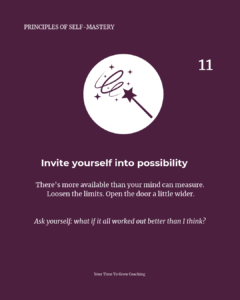 November's Self-Mastery Principle is Invite Yourself Into Possibility, and I've been thinking about how closely this connects with what I heard at the weekend.
When we make decisions based on the stories our inner critic tells us, our world can become smaller without us really noticing.
We rule things out or we decide what other people think and we assume we know what's possible based on what's happened before.
And sometimes we become so convincing in our explanations that we forget we haven't actually tested them.
I know I've done this in my business. I've held back from making invitations because I thought I already knew the answer.
But an invitation is simply an invitation. It gives another person information and allows them to make their own choice.
When I decide not to ask because I'm afraid of hearing no, I'm making their decision for them and I'm making mine from fear.
What might happen if I approached that same situation from love?
I would remind myself that what I offer has value and recognise that someone else's response doesn't determine my worth. I would make the invitation because I genuinely believe it could be helpful, and allow the other person to decide.
They might say yes. They might say no. Either way, I've shown up as the woman I'm choosing to be and I've allowed something to be possible that wouldn't have been possible if I'd rejected myself before asking.
What if you stayed on your own side?
I've spent much of this year learning to recognise and own who I am, rather than continually looking towards some future version of myself who will finally be ready.
This weekend's experience has added another layer to that understanding because knowing who I am doesn't mean my inner critic will never speak again. It doesn't mean I won't experience fear, doubt or the temptation to retreat into familiar patterns.
However, I can choose how I respond and as Elizabeth Gilbert says in her book Big Magic, fear can sit in the back sit, fear doesn't get to drive the car!
I can notice the story without automatically believing it and can question whether I'm being accurate about what I know. I can recognise when I'm trying to protect myself from a rejection that hasn't happened and then I can choose not to abandon myself in the process.
Self-love doesn't have to be another thing I need to get better at, another standard to measure myself against or another reason to criticise myself when I don't get it right.
It can be the practice of returning to myself and choosing how I want to live. And when I think about inviting myself into possibility, perhaps that's where it begins.
With allowing myself to desire what I desire, acknowledging the fear that might come with it and giving myself the opportunity to find out what happens.
So this week, I'm leaving you with a question inspired by what I heard from Anita Moorjani:
If you made your next choice from love rather than fear, what might become possible?