

Being “the good one” often begins as a compliment.
The helpful one. The reliable one. The agreeable one. The person who makes things easier for everyone else. For many capable women, this role formed early and was reinforced repeatedly. It kept the peace, reduced tension, and earned approval.
Over time, being good became more than behaviour. It became identity; what starts as a strength can quietly become automatic.
How the Role Begins
Children are remarkably perceptive. Even without explicit instruction, they notice which behaviours keep things calm and which create difficulty.
Helpfulness may be praised, agreement may avoid conflict and reliability may bring appreciation.
When certain responses consistently produce positive outcomes, the nervous system learns to repeat them. Gradually, those responses become the safest way to navigate the environment.
The role of “the good one” forms through repetition rather than conscious decision.
When Strength Becomes Habit
Being thoughtful, dependable, and cooperative are valuable qualities. The challenge arises when these behaviours stop being choices and start becoming expectations.
Agreeing automatically instead of considering what you need, and helping before anyone has asked. Taking responsibility for things that were never truly yours.
The behaviour feels natural because it has been practised for years. It may even feel uncomfortable to do anything else. At this stage, goodness is no longer simply kindness; it has become a habit.
The Quiet Cost
The cost of this pattern shows up quietly:
- Energy becomes depleted.
- Resentment appears unexpectedly.
- Personal needs are postponed again and again.
- Boundaries feel difficult to express.
None of this happens because you intended to neglect yourself. It happens because the role has been running for so long that it no longer feels optional. When behaviour becomes habit, choice fades into the background.
Everything Is a Choice
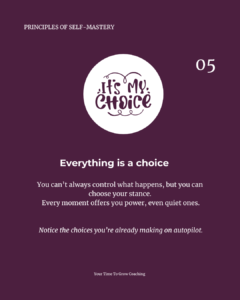 One of the core principles of self-mastery is Everything Is a Choice.
This does not mean that every behaviour is consciously decided in the moment. Many actions are shaped by long-standing patterns and nervous system responses.
What it does mean is that choice can be reclaimed once those patterns become visible.
Recognising the habit creates the possibility of a different response. Without awareness, the role simply continues.
The Moment Before Yes
Many people who identify with the “good one” notice a particular moment during interactions.
A request appears, someone expresses a need, and so an expectation hangs in the air. Before thinking, the answer is already forming: yes.
Learning to recognise that moment is powerful. The pause before responding creates space to consider what is actually needed. Sometimes the answer will still be yes. At other times, a different response becomes possible. That brief pause restores choice.
Goodness Without Self-Abandonment
Letting go of automatic goodness does not mean becoming uncaring or unkind. It means allowing kindness to remain a conscious act rather than an obligation.
Helping because you want to help feels very different from helping because you feel you must.
Agreeing because it aligns with your values feels different from agreeing because disagreement feels unsafe.
Reliability can still be part of who you are. The difference is that it becomes something you offer, not something you perform.
Updating the Pattern
Changing a long-standing role rarely happens overnight. The nervous system prefers familiarity, even when familiarity is exhausting.
Instead of forcing dramatic change, begin with small moments of reflection:
- Notice when the automatic response appears.
- Pause before committing to something new.
- Ask yourself whether the choice feels aligned or habitual.
Each moment of awareness creates a little more flexibility. Over time, those small shifts accumulate.
A Different Kind of Strength
There is real strength in being someone others can depend on. There is also strength in recognising when the role has become too rigid.
Self-mastery invites a more spacious version of goodness: a version where kindness includes yourself, reliability exists alongside boundaries, and agreement is thoughtful rather than automatic.
You do not have to stop being the good one. You simply get to decide what goodness means now.
An Invitation
If you recognise yourself in this pattern, begin by noticing the moments when the role appears.
Pay attention to the impulse to help, fix, or agree before thinking.
Then ask a simple question:
Is this a choice, or a habit?
That moment of reflection is where change begins.
And slowly, the space between habit and choice grows.
If you’re exploring how protective strategies shape your behaviour, the Protective Strategies Quiz can help you recognise the patterns that influence these everyday decisions.