

Many of the patterns we carry feel automatic.
A comment lands and irritation rises instantly. An email arrives and tension appears in your shoulders. Someone asks for help and you say yes before you’ve even considered whether you have the capacity.
Moments like these can make behaviour feel inevitable, as though reaction is the only available option.
Yet there is almost always a small space between the trigger and what happens next.
Inside that space lives choice.
Why Reactions Feel Automatic
Most protective strategies operate quickly. The nervous system scans for cues of threat, familiarity, and expectation, then offers the response that has worked before.
Overfunctioning appears when responsibility feels necessary.
People-pleasing surfaces when harmony feels important.
Independence arrives when vulnerability seems risky.
None of these responses require conscious thought. They were learned through repetition and reinforced over time.
The system moves fast because speed once meant safety.
The Invisible Pause
Even when a reaction feels immediate, a pause still exists.
It may only last a fraction of a second. Most people never notice it because the body moves from trigger to behaviour without conscious awareness.
When awareness increases, that tiny pause becomes visible.
A surge of irritation is noticed before words leave your mouth.
An impulse to fix someone’s problem becomes recognisable.
A familiar urge to prove yourself appears in the body.
Nothing has changed externally. Internally, though, something important has shifted.
You can see the moment before the behaviour.
Everything Is a Choice
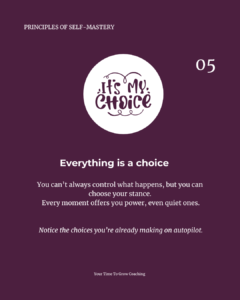 One of the central principles of self-mastery is Everything Is a Choice.
This idea is often misunderstood. Choice does not mean controlling every emotion or eliminating instinctive reactions. Feelings arise naturally and quickly.
Choice lives in the response that follows.
Recognising the pause allows you to engage with that response consciously. Instead of reacting automatically, you gain the ability to decide what happens next.
Sometimes the choice will still be the familiar behaviour. That is part of the process. What changes is the awareness that another option exists.
Micro-Choices Shape Behaviour
Large transformations rarely happen through a single dramatic decision. More often, change is built through small moments of awareness repeated over time.
Pause before answering a question.
Breathe before sending a message.
A moment of curiosity when irritation appears.
These are micro-choices.
They may seem insignificant, yet they gradually reshape how the nervous system responds to triggers. Each pause introduces the possibility of a different outcome.
Over time, those moments accumulate.
Responding Instead of Reacting
Reaction is fast and reflexive. It happens when the nervous system pulls from familiar patterns without conscious involvement.
Response requires presence.
Responding involves noticing the impulse, acknowledging it, and deciding how to move forward. Sometimes that decision aligns with the original reaction. At other times, it introduces something new.
Instead of fixing immediately, you might ask a question.
Instead of saying yes automatically, you might pause.
Instead of suppressing frustration, you might express it calmly.
The difference is subtle but powerful.
Response introduces agency.
Why the Pause Matters
The pause between trigger and behaviour is small, yet it changes everything.
Without that pause, patterns remain invisible. Behaviour feels predetermined. Identity becomes tied to habits that were formed long ago.
Once the pause is recognised, the relationship with those habits shifts.
You are no longer only the person who reacts.
You become the person who notices.
That shift restores a sense of authorship in your life.
Practising the Pause
Learning to notice the pause takes practice. Expecting it to appear consistently right away can create unnecessary pressure.
Start small.
Pay attention to moments when emotion rises quickly. Notice what happens in your body. Observe the impulse that follows.
Even if the reaction still occurs, the act of noticing matters.
Awareness builds capacity. Capacity creates choice.
Reclaiming Agency
Many people begin this work believing their patterns control them. Over time, something changes.
Patterns still appear, but they are no longer the only option. The space between trigger and behaviour grows slightly wider. Decisions become more conscious.
Agency returns gradually.
This is what self-mastery looks like in practice. Not perfection, not control, but the ability to meet familiar moments with increasing awareness.
An Invitation
The next time you feel a familiar reaction rising, see if you can notice the moment before the behaviour.
Pause briefly.
Ask yourself:
What am I about to do?
Is this response serving me right now?
Is there another option available?
That small moment of reflection may not change everything immediately.
What it does is remind you that choice is already present.
And from there, change becomes possible.
If you’re exploring how protective strategies influence your reactions, the Protective Strategies Quiz can help you recognise the patterns shaping those moments.