

Many of us don’t think of ourselves as people who silence ourselves. We speak, contribute and lead. And yet, in the moments that matter, we hold back more than we realise.
It doesn’t look like silence in the obvious sense. There are no missing voices or empty spaces. Instead, it shows up in small, almost invisible moments where something true is softened, edited, or left unsaid.
Over time, those moments accumulate.
The Subtle Ways You May Be Silencing Yourself
Silencing rarely feels deliberate.
It might look like holding back a thought in a meeting. At other times, it appears as softening an opinion so it lands more comfortably. A point may be let go because it feels easier not to pursue it. Tone may shift to avoid being perceived as too direct or too much.
None of these behaviours register as silence. They feel like being reasonable, professional and considerate. That is what makes them so easy to miss.
What’s happening in these moments isn’t a lack of confidence. It’s where your attention goes: outward, i.e. towards how it will land, how it will be received, how it might be judged.
And in that shift, you leave yourself.
How the Pattern Forms
These responses are not random. Often, they are shaped by something familiar. A desire to keep things smooth. An instinct to avoid conflict. A pull towards maintaining approval.
Over time, your attention learns to move outward first. It scans the room, anticipates reactions and it adjusts before you’ve fully expressed yourself. With enough repetition, silencing yourself becomes automatic. And when it becomes automatic, it stops feeling like a choice.
Where Choice Returns
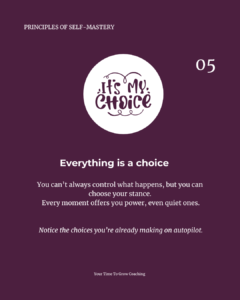 The work is not about forcing yourself to speak more.
It’s about noticing the moment your attention leaves you.
Because there is a moment before you soften the sentence, hold back, or adjust.
If you can see that moment, something shifts. You are no longer fully inside the pattern. That is where choice begins to return.
This is the deeper layer of choice. Not forcing a different response, but noticing where your attention goes in the first place. Because choice doesn’t disappear, it becomes harder to access when your attention is outside of yourself. And the moment your attention returns to you, choice becomes available again.
The Quiet Cost of Silencing Yourself
The impact of this pattern is not always immediate. On the surface, things may continue to work. Relationships remain intact. Work progresses. Life carries on as expected.
Over time, though, something changes internally. A quiet disconnection from your own voice can begin to form. Expression feels slightly constrained, even when everything appears fine from the outside.
Silencing yourself repeatedly creates a version of you that looks capable and feels slightly disconnected from your own truth.
The Shift Begins With Awareness
Change here does not come from forcing yourself to say everything you think.
It does not require becoming more outspoken overnight or pushing against every instinct to soften.
The work begins with noticing: the moment you hold back, perhaps the sentence you adjust or when you choose comfort over truth.
Each moment of awareness creates space.
And in that space, something else becomes possible.
A Different Way to Show Up
As awareness grows, your relationship with your own voice begins to change.
You may still choose to soften your words. You may still decide not to say something in a particular moment. The difference is that the decision becomes conscious rather than automatic.
That shift is subtle, but it is significant. You are no longer reacting from a pattern. You are responding from awareness. Over time, those small moments reshape how you show up.
A Next Step
This is exactly the work we explore inside Taking Off the Armour.
Not forcing change.
Not becoming someone else.
But noticing where you’ve learned to hold back, and beginning to stay with yourself long enough to choose differently.
Closing Reflection
Where in your life are you silencing yourself and calling it "professional"?