
Last week, I was talking to my coach, Rebecca, about growth and how we don't always recognise it when it's happening.
We can spend months, sometimes years, working on ourselves, becoming more aware of our thoughts, understanding our patterns and making different choices. Yet when we look back, we don't necessarily acknowledge all the ways we've changed.
What we do notice, however, are the moments when we slip back into familiar behaviour.
The times we doubt ourselves, avoid something uncomfortable, say yes when we really wanted to say no or find ourselves reacting in exactly the way we thought we'd moved beyond.
And then comes the judgement.
I thought I'd dealt with this.
Why am I doing this again?
Clearly I haven't changed as much as I thought.
I recognised this in myself during our conversation. Despite everything I've learned and experienced over the past year, I can still be remarkably quick to notice where I've fallen short and overlook the evidence of how far I've come.
It made me wonder whether we're sometimes so busy measuring the moments when we struggle that we fail to recognise the growth happening around them.
When the familiar feels easier
We talk a lot about stepping outside our comfort zones, but I think it's worth remembering that our comfort zone isn't necessarily somewhere we're happy. Sometimes it's simply somewhere familiar.
When we begin making different choices, we are moving beyond ways of thinking and behaving that we've practised for years.
If you've always been the person who takes responsibility for everyone else, setting a boundary might feel uncomfortable, even when you know it's the right thing to do. If you're used to keeping your opinions to yourself, speaking up might leave you questioning everything you've said afterwards.
And if you've spent years believing that being capable means doing everything yourself, asking for help might feel surprisingly difficult.
We can understand intellectually why these changes are good for us, but that doesn't mean they immediately feel comfortable. Sometimes the old way of doing things feels easier, particularly when we're tired, uncertain or facing a difficult situation, and occasionally we return to it.
I don't think that necessarily means we've stopped growing. It may simply mean we're learning to respond differently in situations where our old habits have been deeply ingrained. The difficulty is what we tell ourselves when that happens.
Why do we notice the setbacks more than the progress?
This was the part of my conversation with Rebecca that really stayed with me. I've become much more aware of my own patterns, particularly the ways I can shrink, overthink or hesitate when something feels uncertain.
I've also become much better at recognising my capabilities, expressing myself and trusting my own judgement and when one of those old behaviours appears, I can still find myself giving it far more attention than all the occasions when I've chosen differently.
It's rather like climbing a mountain, looking back at how far you've come and deciding none of it counts because you stumbled over a rock...except sometimes we don't even look back. We're too busy examining the rock!
I wonder how many of us do this; we remember the boundary we didn't hold, but forget the conversations where we expressed ourselves clearly. We focus on the opportunity we avoided, overlooking the many occasions when we put ourselves forward.
We notice the day we didn't follow through on our intentions, but barely acknowledge the weeks when we did, and because we're so focused on the moments that didn't go as planned, we create a story that we're not progressing.
I think there's something particularly curious about this for those of us who have high expectations of ourselves; we can become so accustomed to striving for improvement that we barely pause to recognise what's already changed.
Progress becomes the minimum expectation, while anything less than perfect becomes something to examine, question or criticise, and I wonder what that does to our willingness to keep growing?
Are we measuring growth against perfection?
I've been reflecting on how often I've expected growth to look like a steady progression towards the person I want to be. I learn something about myself, recognise a pattern, make a different choice and assume that I've moved beyond the old behaviour.
Then something happens, I respond in a familiar way and suddenly I'm questioning whether I've really changed at all...why would I expect years of habitual thinking and behaviour to disappear simply because I've become more aware of them?
I know from my coaching work that change takes practice. I know that different situations can bring out different responses and that learning isn't always a straightforward process.
Yet knowing this doesn't always stop me from judging myself when I'm the one experiencing it! For me, the expectation itself is part of what makes growth uncomfortable.
If I believe that becoming more self-aware means I should no longer struggle with certain things, then every difficult moment becomes evidence that I'm not where I should be. And if I continually measure myself against an ideal version of who I think I ought to be, I'm unlikely to feel particularly satisfied with who I'm becoming.
I'm beginning to see that there's a difference between having high standards for myself and expecting myself to get everything right. I can be committed to growing without demanding that the journey is flawless.
Recognising the growth we can't always see
Something I've been learning through my own Self-Mastery journey is that growth isn't always immediately visible in our external results. Sometimes it shows up in the way we respond to a situation that would previously have overwhelmed us.
Perhaps we recover more quickly from disappointment, or we recognise when we're making assumptions about what someone else might think. We might notice ourselves wanting to retreat into a familiar pattern and, even if we don't manage to make a different choice in that moment, we understand what's happening.
There was a time when I could find myself caught in a familiar pattern without recognising it. I'd overthink, withdraw or convince myself that an opportunity wasn't right for me, without necessarily questioning the story I was telling myself.
Now I'm much more likely to recognise those thoughts and become curious about what's underneath them. I don't always get it right, and sometimes I only recognise what's happened afterwards...and that's still progress. I think it's important to acknowledge that, rather than dismissing it because the outcome wasn't what I wanted.
When I look back over the past year, there is plenty of evidence that I've grown. I've had experiences that have challenged me, made decisions I might previously have avoided and become increasingly willing to own who I am and what I'm capable of.
Yet I can still overlook those experiences in favour of the occasional moment when I doubt myself, so part of my growth now is learning to recognise it more accurately.
What happens when we judge ourselves for struggling?
Over the past couple of weeks, I've been reflecting on something I heard Anita Moorjani say about self-love being the rejection of self-loathing, and the importance of making choices from love rather than fear.
It's a conversation that seems to be following me into every area of my life at the moment! Last week, I explored how often I've made my own acceptance conditional on achieving the results I want and now I'm recognising another way that conditional acceptance can appear.
I can be proud of my growth when I'm making progress, feeling confident and doing the things I said I would do. But what happens when I struggle?
Do I continue treating myself with the same kindness and respect, or does my inner critic immediately start questioning everything?
I think this matters because the way we respond to ourselves during difficult moments can influence what happens next. If I criticise myself for returning to an old pattern, I can easily become caught up in disappointment and frustration. My attention moves away from understanding what happened and towards judging myself for allowing it to happen.
And that judgement doesn't necessarily help me make a better choice next time. In fact, it can make the whole experience of growth feel exhausting.
I'm not suggesting that we should avoid accountability or pretend that our behaviour doesn't matter. I still want to recognise when I've made a choice that doesn't reflect who I want to be. I want to understand what happened and take responsibility for doing something differently, and I can do that without turning the experience into a judgement about who I am.
I can acknowledge that something didn't go as I'd hoped while also recognising the progress I've made, which makes it easier to keep going.
Inviting yourself into possibility
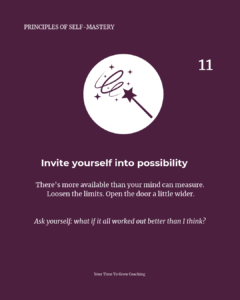 November's Self-Mastery Principle is Invite Yourself Into Possibility, and I've been thinking about how much possibility requires us to become comfortable with not knowing.
We can't always predict how someone will respond when we set a boundary, put ourselves forward or begin behaving differently.
We might feel awkward, make mistakes or occasionally return to habits we've spent years trying to change.
However, if we only acknowledge our growth when everything goes to plan, we risk overlooking much of the journey.
I've also been thinking about my word for 2027, Release, and how it might apply here too. Perhaps I can release the expectation that growth should be a smooth, uninterrupted journey; I can release the need to get every choice right before acknowledging how far I've come.
And I can release some of the judgement I've attached to those moments when I find myself doing something familiar. That doesn't mean abandoning my intentions or accepting patterns I genuinely want to change. It means giving myself the space to learn without making every stumble a verdict on my progress.
Growth isn't measured by how rarely we return to old patterns; instead, we can measure growth by how differently we respond when we notice them, and when we do find ourselves in familiar territory, we can acknowledge where we are without forgetting how far we've travelled.
So, as you go about your week, I wonder whether there's an area of your life where you've been focusing more on the moments you've struggled than on the progress you've made.
What might change if you began giving your growth as much attention as you give your setbacks?