

There’s a moment many of us recognise, even if we don’t always talk about it. You've had an idea, it feels exciting, spacious and full of possibility.
You think about it. Journal about it. Maybe even speak it aloud. And then… you decide to take action.
That’s the moment everything changes.
Suddenly, the idea that felt light and energising becomes heavy. Doubt creeps in; confidence wobbles. You might feel anxious, stuck, overwhelmed, or strangely incapable. Thoughts like “Who do I think I am?”, “I can’t do this”, or “What if it goes wrong?” arrive uninvited.
This is the moment people often describe as “now it’s real.” Psychologically speaking, it’s one of the most misunderstood aspects of the change process.
Why the Fear Shows Up When Action Begins
The fear of taking action isn’t a sign that something is wrong. It’s a sign that something meaningful is happening.
When an idea stays in your head, it’s safe, it stays theoretical and therefore it can’t be judged. When it hasn’t been acted on, it can’t fail.
The moment you move from idea to action, your brain registers exposure.
From a psychological perspective, action equals risk. Not necessarily physical risk, but emotional and social risk. The brain’s job is to keep you safe, and safety has historically meant staying within what’s known and predictable.
Action threatens that.
The Brain’s Job Isn’t Growth; It’s Protection
Your nervous system isn’t designed to help you grow. It’s designed to help you survive.
So when you step towards something new, your system scans for danger:
- The fear of failure is often the first to appear.
- Judgment from others quickly follows.
- For some, the worry is disappointing people they care about.
- And underneath it all sits the deeper fear: confirmation that they’re not good enough.
Even positive change can feel threatening if it risks identity, belonging, or self-image.
This is why the fear often feels disproportionate. You’re not reacting to the task itself; you’re reacting to what the task symbolises.
Identity Is the Real Trigger
At the heart of the fear of taking action is identity. As long as something is an idea, it doesn’t ask you to redefine who you are.
Action does.
Taking action might move you from:
-
thinker → visible creator
-
helper → leader
-
student → authority
-
behind-the-scenes → seen
That shift can feel destabilising, even if it’s something you consciously want.
Self-doubt often appears not because you can’t do the thing, but because doing it would require you to let go of an old version of yourself.
Why We Suddenly Feel “I Can’t Do This”
That internal voice that says “I can’t do this” is rarely about capability.
It’s usually about the fear of being seen or getting it wrong. It might feel like the fear of success and its consequences, of not being able to go back.
This is a protective response. Your system is trying to pull you back to familiarity, even if familiarity is limiting.
This is where procrastination, perfectionism, overthinking, or “needing more clarity” often appear. They’re not flaws; they’re strategies.
Awareness Before Action (Again)
One of the most powerful self-mastery practices here is awareness before action.
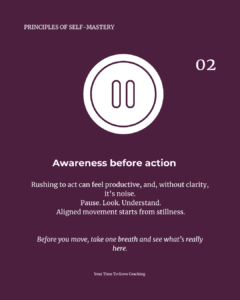
Instead of asking “How do I get rid of this fear?”, try asking:
-
What is this fear trying to protect me from?
-
What identity feels at risk right now?
-
What does my system think might happen if I proceed?
When you name the fear, you reduce its power. When you understand it, you stop fighting yourself.
Self-mastery isn’t about forcing confidence.
It’s about staying present with yourself while you move forward.
Confidence Is Not a Prerequisite, It’s a Result
This is one of the biggest myths we internalise: “I’ll act when I feel confident.”
In reality, confidence is an energetic state created by action, not something you wait to feel beforehand. Confidence grows when you take the step despite fear and you survive the discomfort. You realise you can respond to whatever happens.
The nervous system learns through experience, not logic. Each time you act and remain safe, your system updates its beliefs.
A Gentle Reframe for That Moment
When that “now it’s real” fear arrives, try this instead of retreating:
-
Acknowledge: “Of course this feels scary, I’m stretching.”
-
Normalise: “This is part of the process, not a sign to stop.”
-
Ground: notice your breath, your body, your feet on the floor
-
Choose: “I can take the next small step while staying with myself.”
You don’t need to eliminate fear. You need to move with it, consciously.
The Self-Mastery Invitation
Every time you reach the edge between idea and action, you’re being invited into a deeper level of self-trust. Not because the outcome is guaranteed, but because you are.
Self-mastery is learning to trust your capacity to respond, adapt, and stay connected to yourself even when things feel uncertain.
That moment when it suddenly feels real? It’s not failure. It’s growth asking if you’re willing to meet it.